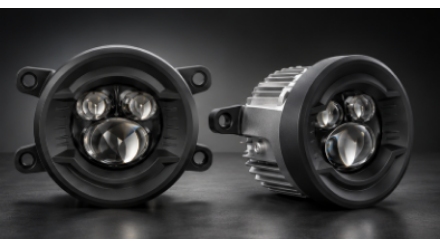







Projector, reflector and laser are three different ways of shaping headlight output. A reflector bounces light off a shaped mirror, a projector focuses it through a lens with a cutoff shield, and a laser headlight uses laser diodes to excite a phosphor that produces the light. For most drivers and most upgrades, the practical choice is between a reflector and a projector — laser remains a factory-fitted premium technology.
How each one works
| Reflector | Projector lens | Laser headlight | |
|---|---|---|---|
| Light source | Halogen, LED or HID bulb | LED or HID, focused by a lens | Laser diodes + phosphor |
| Beam control | Shaped mirror bowl | Lens + cutoff shield | Lens + phosphor, very long range |
| Cutoff | Soft, depends on the bowl | Sharp, by design | Sharp, by design |
| Cost | Lowest | Medium | Highest |
| Common use | Standard cars, older models | Mid-range and premium cars, upgrades | Premium factory-fitted cars |
Reflector: simple and proven
A reflector headlight places the bulb inside a precisely shaped mirrored bowl. The bowl's curves direct the light forward and shape the beam. Reflectors are cheap, reliable and easy to manufacture, which is why they are still the most common headlight type. Their weakness is precision: the beam pattern depends entirely on the bowl's shape and on the bulb sitting in exactly the right position. An LED bulb in a reflector designed for halogen often produces a fuzzy cutoff and scattered light, because the LED chip is not in the same place as the halogen filament was.
Projector lens: controlled and sharp
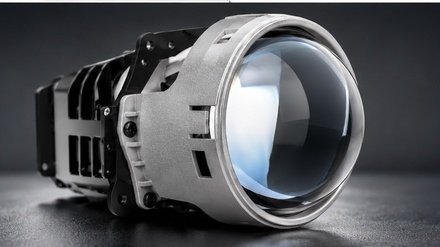
A projector lens puts the light source behind a lens, with a metal cutoff shield between them. The shield blocks the top part of the light, creating the sharp horizontal cutoff that keeps glare out of oncoming drivers' eyes. The lens then spreads the remaining light evenly across the road. A Bi-LED projector uses one lens for both low and high beam — the shield moves to switch modes. Projectors give the best beam control of the three for aftermarket use, and they are the standard choice for a headlight upgrade.
A laser headlight does not shine laser light onto the road. Instead, blue laser diodes excite a phosphor material, which glows and produces a very bright white light. That light is then shaped by a lens, like a projector. The advantage is range: laser high beams can reach much farther than LED high beams, which is why they appear on premium cars for high-speed night driving. The disadvantages are cost, complexity and heat management. Laser headlights are factory-fitted systems, not a practical aftermarket upgrade — they need the car's full headlight assembly, cooling and control electronics.
Which one should you choose?
- You have a reflector and a tight budget: a quality LED bulb matched to the housing, with a beam-pattern check after fitting.
- You want the best beam pattern: a Bi-LED projector lens retrofit.
- You are buying a new premium car: laser is an option worth considering for long-distance night driving — but it is a factory choice, not something to add later.
- You sell to end customers: explain the difference with beam-pattern photos. Most customers have never seen a cutoff comparison, and one photo is worth a thousand words.
FAQ
Is a projector always better than a reflector?
For beam control, yes — a projector's sharp cutoff and even spread are hard for a reflector to match. But a well-designed reflector with the correct bulb is still a good headlight, and it costs far less.
Can I convert a reflector headlight to a laser headlight?
No, not practically. Laser headlights are complete factory systems with their own cooling, optics and electronics. A projector lens retrofit is the realistic upgrade path.
Why do laser headlights cost so much?
The laser diodes, the phosphor, the cooling system and the precision optics are all expensive to make, and the volumes are low. The price reflects a premium factory system, not just the bulb.