







You can test an LED headlight beam pattern with a flat wall, level ground and a tape measure: park about 7–8 metres from the wall, switch on low beam, and look for a clean horizontal cutoff with a small step, even brightness across the pattern, and no light scattered above the line. A fuzzy cutoff, a bright hotspot, or light above the line means the bulb is fitted wrong or the lamp is the wrong type for the housing.
The setup
- Level ground — a slope changes the cutoff height and makes the test meaningless.
- A flat, light-coloured wall — a garage door or a workshop wall works well.
- Distance: about 7–8 metres (25 feet) from the wall to the front of the car. Mark the distance so you can repeat the test.
- Fuel and load: test with the car in its normal state — half a tank, no heavy load in the boot — because load changes the beam height.
- Tyre pressure: normal, for the same reason.
What a good low-beam pattern looks like
- A clean horizontal cutoff. The top edge of the light is a sharp line, not a blur. Above the line is dark; below it is lit.
- A small step. On one side the cutoff steps up slightly — to the right for left-hand drive markets, to the left for right-hand drive markets. That step lights the roadside without blinding oncoming drivers.
- Even brightness. The light is evenly spread across the pattern, with no harsh bright spot in the middle and no dark patches.
- Symmetry. Both headlights produce the same shape at the same height.
Common faults and what they mean
| What you see | Likely cause | Fix |
|---|---|---|
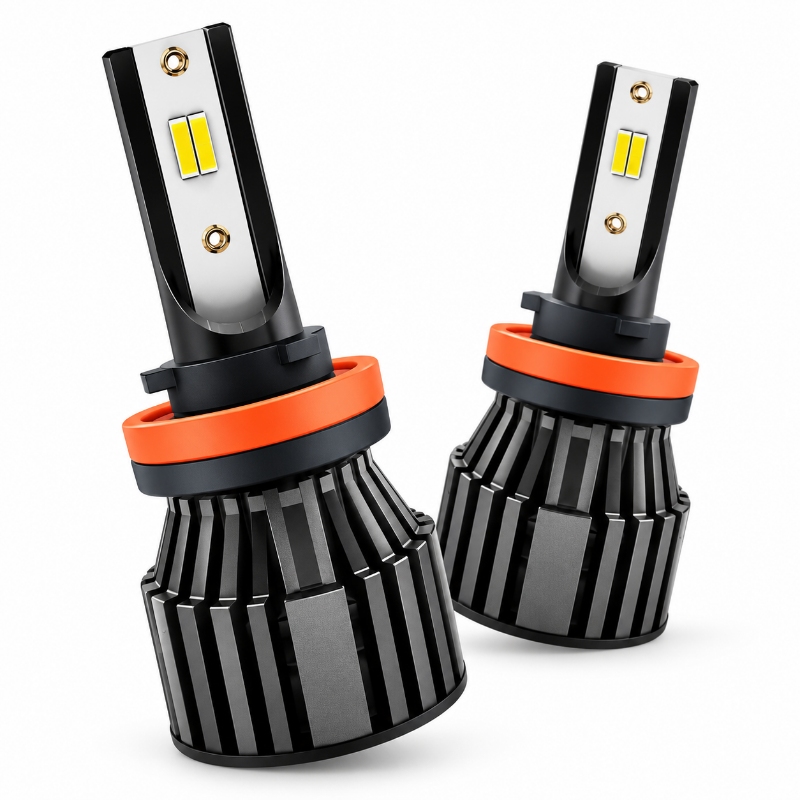
| Fuzzy, blurred cutoff | LED chips facing the wrong way, or a bulb that does not match the housing | Refit the bulb with chips facing left and right; check the bulb type |
| Bright hotspot in the centre | Bulb seated too far forward or back | Reseat the bulb fully and lock the clip |
| Light scattered above the cutoff | Wrong bulb for a reflector housing, or a damaged reflector | Fit a bulb matched to the housing, or consider a projector lens |
| One side higher than the other | Aiming screws out of adjustment, or a bulb not seated | Adjust the screws; reseat the low bulb |
| Pattern tilted or rotated | Bulb rotated in its socket | Rotate the bulb until the pattern is level |
How to aim with the adjuster screws
- Mark the headlight centre height on the wall with tape.
- The cutoff should sit slightly below the headlight centre height at 7–8 metres — typically a few centimetres lower.
- Turn the vertical adjuster screw to raise or lower the beam, and the horizontal screw to move it left or right.
- Adjust one headlight at a time, covering the other with a cloth.
- Re-test after a short drive, because vibration can settle a newly fitted bulb.
When a wall test is not enough
A wall test checks the pattern shape, not the absolute brightness or the legal compliance. For a formal result — for example, before a roadworthiness inspection — use a proper beam setter, which measures the cutoff height and the light distribution precisely. If a lamp passes the wall test but fails the beam setter, the problem is usually aiming, not the bulb.
FAQ
How far from the wall should the car be?
About 7–8 metres. Closer and the pattern is too small to judge; farther and the cutoff is hard to see. Keep the same distance every time so results are comparable.
Why does the cutoff look fuzzy after fitting LED bulbs?
Usually the LED chips are facing up and down instead of left and right. Turn the bulb 90 degrees and test again.
Can I test high beam the same way?
High beam has no cutoff by design — it is meant to throw light far ahead. Test it for even spread and for a symmetrical pattern, not for a cutoff line.