






CANbus is the network that lets a car's electronic systems talk to each other — and one of its jobs is to monitor the headlight bulbs. It measures how much current each bulb draws, and if the current is far below what a halogen bulb would draw, it assumes the bulb has failed and shows an error, or cuts the power, which makes the LED flicker. A decoder fixes this by drawing extra current so the car sees a normal bulb.
How CANbus bulb monitoring works
Modern cars do not just switch bulbs on and off. The body control module sends a small test current through each bulb circuit, even when the lights are off, and measures the resistance. A halogen bulb has a known resistance; if the reading is far off, the car logs a bulb failure and warns the driver. This system was designed for halogen bulbs, which draw a predictable current and have a filament that fails in a predictable way.
Why LED bulbs confuse it
An LED bulb draws far less current than the halogen bulb it replaces — often less than half. To the CANbus system, that low draw looks exactly like a burnt-out bulb. The car's responses vary by model:
- Dashboard warning: a bulb-out message or warning light, even though the LED works fine.
- Flicker: the car sends repeated test pulses, and the LED — which responds instantly — flashes with each pulse.
- Switching off: some cars cut power to the circuit after a few failed checks, so the LED goes dark.
- Hyperflash or error codes: less common for headlights, more common for indicators, but the same cause.
What a decoder does
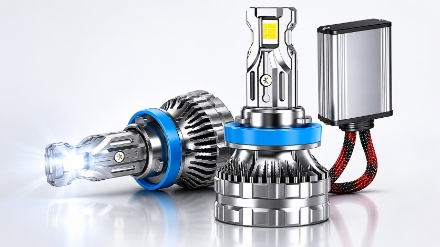
A decoder (also called a CANbus adapter, error canceller or load resistor) sits between the car and the LED bulb. It draws extra current so the total draw looks like a halogen bulb to the monitoring system. There are two main types:
- Resistor-based decoders: simple and cheap; they turn the extra current into heat, so they run hot and must be mounted away from plastic and wiring.
- Capacitor-based decoders: smoother, less heat, and better at filtering the test pulses that cause flicker. They cost more but are the better choice for most cars.
A decoder does not change the bulb's light output — it only changes what the car's monitoring system sees.
Which cars usually need one
- European cars (Volkswagen, Audi, BMW, Mercedes and others) are the most common cases — their monitoring is the strictest.
- Cars with bulb-out warnings on the dashboard are the obvious candidates.
- Cars that flicker with LED bulbs usually need a decoder even if no warning appears.
- Older cars and most Japanese and American cars often work without one, because their monitoring is simpler or absent.
The only reliable way to know is to test: fit the LED bulb, switch the lights on, and watch for warnings and flicker over a few minutes.
FAQ
Will a decoder fix flickering?
In most cases, yes — if the flicker is caused by CANbus test pulses. If the flicker comes from a loose connection or a failing driver, a decoder will not help.
Does a decoder use extra power?
Yes, a little. That is the point — it draws current so the car sees a normal bulb. The extra draw is small compared to the power saved by switching from halogen to LED.
Can a decoder damage my car?
A good-quality decoder, fitted correctly and mounted away from heat-sensitive parts, is safe. A cheap resistor left touching plastic or wiring can melt things — mount it on metal, away from the headlight housing's plastic parts.